Monday, January 30, 2017

Exquisite Text


Artist Statement written by Rick Chestnut and Jared Richardson:


For our project, we chose to create a conversation between two members of a family that haven’t spoken in a while. This is a story based on a real communication between father and son. The son is very successful at what he does, and has several companies who want him in their employ. He is loyal, and finds it hard to make changes when an offer is made. It is always difficult to see the correct way to go. Besides being based on real experiences, the idea for our story came from a short story about how “jobs are like one big balancing act.”

This assignment was challenging for us in that it had to be procedurally generated, just like an exquisite corpse. Rather than scripting it all out, we decided to let the conversation between us happen naturally, over the course of a weekend. Originally we had an idea for how we wanted our conversation to go, but because of how the topic would change in our conversation (and because of our conflicting schedules in real life, which would cause our texts to be sent at sporadic times), we ended up telling a slightly different story than we had intended—with a much different ending than we expected. Additionally, each of us had a very different style of texting, which really shows through in the vocabulary, length, and even emojis used in our conversation.

With all this being said, we’ve learned that there is such a huge potential in using this type of medium to tell stories. While our execution was flawed, there are others who have learned to perfect the use of dialogue to tell a story. Take Phoenix Wright: Ace Attorney, for example. This 2001 video game by Capcom falls under the “visual novel” genre of games, where the story is told entirely through dialogue, with assistance from some basic images and animated sprites. Every part of the storytelling in the game is told through conversations between the protagonist, Phoenix, and the people he chats with, interviews, and goes up against in a court of law. Even Phoenix’s thoughts are discernable because he “mutters” them out loud (under his breath) for the player to read. Because of this system, which works exceptionally well, the entire game could convey its story without the visuals if it needed too, just like the script to a play.

Visual novels aren’t the only medium that relies principally upon dialogue. Some short stories, comedy sketches, and theatrical plays forego excessive visuals in favor of regular conversations between characters. The only difference between those and this project, however, is how (unless delivered through improvisation) they are all planned ahead of time. In our situation, the story was pieced together, little by little, to create a meaningful interaction between a father and son.

Collection of Dialogue-only stories: https://mjshorts.wordpress.com/tag/dialogue-only-stories/
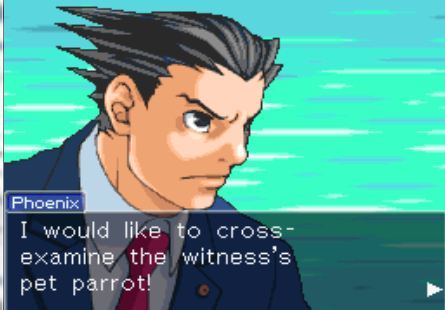
Gameplay video of Phoenix Wright: Ace Attorney: https://www.youtube.com/watch?v=03fHrQJeiM8

Image result for phoenix wright dialogue

Image result for phoenix wright ace attorney best quotes


Monday, January 23, 2017

Music Mosaic


"Do While" by Oval:


The art I’ve created is based on a piece called “Do While,” by electronic music group Oval. My selection is not what you might expect from a typical instrumental track, however. It is from an obscure musical genre known as “glitch music,” where damaged and fragmented CD’s are played to create a unique timbre that is hard to replicate. I chose to create art that has a similar feel to what I experience when I hear this track: unfamiliarity and rhythmic looping.

It’s really hard to describe what “Do While” sounds like, so I did the best I could to show it. Throughout most of the 24-minute piece there are these really glassy, high pitched noises that alternate between the right and left speakers. I felt these noises could best be represented with glass itself, so I shot each of my photos through different pieces of glass: some wet, some tinted, and some frosty. I would then shine different kinds of lights in each one, which would make interesting reflections (and some that would become warped, depending on the type of glass). To me, these give the photos an otherworldly and unique feel, which can be also felt in the track - the distorted sounds throughout the piece sound foreign, not at all like typical instruments. The tones in it constantly loop again and again, creating a kind of hypnotic rhythm. In most of my photos, there is some kind of repeating element - the multiple reflections of a light, several rain droplets in a line, etc. These repetitions are not consistent, but in a way this is how the music is as well: some of the melodic phrases that repeat every few seconds are sometimes modulated. Overall, however, my photos are more about conveying the feel of Oval’s piece, rather than creating direct correlations.

Obviously my art here is very abstract, and its relationship to the music is more apparent to me, the creator, than it is to anyone else. But it would have been hard for me to have done them in any other way—when I listen to “Do While,” I don’t tend to visualize real people or places. Rather, I see lights and shapes, and internally focus on the glassy pseudo-percussion throughout. Much like how Annie Dillard notices different aspects of nature that stand out to her, I have my own perception of the art I consume.

I’m not the first to use abstract images or materials to accompany music, however. Kristian Pedersen, an animator from Norway, created an award-winning short called “The Boyg,” which uses different shapes to resemble a moving serpent, something Pedersen would visualize whenever he listened to an instrumental track which accompanies the piece. This is a perfect example of how different artists can make their own interpretations of other artistic mediums in new and interesting ways. Mine is not super refined by any means, but being able to attempt to represent a piece of music was well worth the time and effort.


“The Boyg,” another example of capturing music with abstract art: https://vimeo.com/169233269

Thursday, January 19, 2017

OFF THE MAP: It's Dark Outside - Media Convergence Done Right

On a spur of the moment, I decided to go view It's Dark Outside, an abstract theater performance that is devoid of dialogue. I had a mild interest because I heard it was very "different" than typical shows that come to BYU. That was pretty much the only expectations I had going in to it. Coming out of it, I was impressed, astonished, and had an overall feeling of melancholy.

It's Dark Outside tells an interesting story. It features an old man who has Sundowning Syndrome, a common malady that elderly people have, where they experience dimentia, particularly in the late evening time as the sun goes down. This man revists old memories, experiences hallucinations, and tries to run away from a man who is persuing him. It's a simple story, but very subject to interpretation, as it's unclear what things are happening in real life, and what are happening in the old man's head.

What's extraordinary about the story, however, is how it is told. There are three actors (all from Perth, Australia) that use a variety of things to progress the narrative: puppetry, masks, costumes, animations, props, shadow puppets, strobe lights, and music. Each one of these is skillfully executed together with other elements to create a very unique experience. One example that really stood out to me happened in the middle of the play. The old man (an actor wearing a mask) hears approaching footsteps (done in the audio track), so he runs away off stage, which transitions to him in animation form on a screen, running through a Western movie-esque landscape. Soon after, his persuexer appears (as a shadow from behind the screen), brandishing a butterfly net, slowly moving in the same direction, and interacting with other lights and animations. It's not very long before the old man re-enters the stage, but this time as a minature puppet, operated by 2-3 of the actors. It's this seamless transition between mediums that makes it easy to become enraptured with the show. I have never before seen something that uses so many widely different forms of performance and new media so well, and without a word spoken the entire time.

Beyond the novelty of it all, It's Dark Outside uses its many different elements to help the audience get a feel for what the main character is experiencing. Obviously you can't say that it's the perfect representation of what dimentia is like, but rather it helps you empathize with those who have it. Annie Dillard, for example, writes about how the world can be experienced in different ways. This is especially true for people born blind who regain their sight — each one reacted to the lights in colors in many different ways. In Dillard's case, her descriptive and poetic words help us as readers visualize her experiences with nature, as if we were in her shoes. Likewise, It's Dark Outside achieves a similar effect. The audience is presented some things that are very abstract, and left to ponder what it would be like to have dimentia. Or, perhaps the show reminds them of someone they know or are close to that is going through it. For me, I found myself contemplating how short life is.

And in the end, that's the beauty of art - every person who sees it can take something different from it.

Image result for it's dark outside byu

Monday, January 16, 2017

Thinking and Writing

Fast Beats and Button Presses

Crypt of the Necrodancer is, in a lot of respects, a pretty standard 2015 indie-video game. It’s a dungeon crawler where the player fights monsters, finds items, and makes their way to the final boss of the level. It boasts an excellent soundtrack, cute 8-bit graphics, and a very simple control scheme. By its own merits, this game would be very similar to many other dungeon crawlers that have come out in recent years—if not for one key difference.


It’s a rhythm game.
Image result for crypt of the necrodancer
Every choice you make in the game, whether it’s moving around the dungeon, attacking an enemy, or using an item—it all has to be done to the beat of the soundtrack. It’s up to the player to perform each action according to the fast-paced tempo of the dance music as they progress through each level. The game won’t even work correctly if you press buttons willy-nilly; every button press must be exact. The mash-up of these two well-known but separate gaming genres (rhythm games and dungeon crawlers) makes for a compelling and unique experience—one that has garnered a very loyal fan following. But the novelty of the premise is not the only reason this game has received “Overwhelmingly Positive” reviews on game services like Steam. Its appeal comes from the natural inclination we have to contribute or “be a part of” the music we hear.


The Rhythms in Our Lives

No matter what amount of musical experience we may have, we all have a tendency to tap our feet, bob our head, or unconsciously bounce when we hear music playing. Normal activities such as driving a car, walking to class, or sitting in the waiting room at the dentist’s office suddenly become much more involved when music is playing, as we tend to move to the beat without even realizing it. Why do we do this? These places clearly aren’t dance floors, so why do we move to the rhythm? Why don’t we just live independently of the music around us? I suggest it’s because it just feels right.


Image result for crypt of the necrodancer

Perhaps it’s because we enjoy feeling like we are contributing to something larger than us, or maybe it’s that we all have a primal instinct to create and engage with music. But whatever the reason, there is something undeniably satisfying about moving to a rhythm. In fact, it feels unnatural not to (even now, as I type this, I find it incredibly hard to not sway back and forth to the music playing on my computer). As we move, we feel as though we are a part of what we hear, as though we are the ones causing the music, when the reverse is actually true.

The same can be said for video games—even non-rhythm based ones. Games with strong beats or catchy music make it tempting to hit the buttons in time with the soundtrack. For example, Koji Kondo designed the soundtrack for the iconic NES game Super Mario Bros. only “after playing the game repeatedly, to gauge how Mario ran and jumped, identifying the character’s unique “rhythm” in order to create a satisfying counterpoint between music and gameplay” (Donnelly). In this case, the music was inspired by the game’s controls, to make the player’s in-game choreography of Mario as natural as possible. It is this aspect of game design that Crypt of the Necrodancer capitalizes on even more than Super Mario Bros. did.


Necrodancer’s Genius Design

Everything about Necrodancer is centered on rhythm. The game mechanics are pretty simple: move, attack, and use items at the same time as the pulsing percussion beat of the soundtrack. There’s even a little visual aid on-screen to help you keep to the rhythm. Failing to do so causes the player’s character to freeze, leaving them vulnerable to damage from enemies that dance/attack you.

This core, rhythm-based gameplay is what makes the game so enticing. Unlike a traditional rhythm game, (such as Guitar Hero) where one must use timed series of button-presses to imitate a real instrument, Necrodancer lets the player decide what he or she wants to do in the game, provided it’s done to the beat. By doing so, the player has autonomy in how they strategically move and attack, but they also get the satisfaction of feeling as though they themselves are a part of the soundtrack. Even the sound effects caused by the player complement the soundtrack; the sound of each swing of your sword is short and precise, meshing well with the fast-paced drum beat.

Overall, Necrodancer feels good to play, and it’s worth pointing out that its creator, Ryan Clark, came up with the rhythm gimmick “accidentally.” In an interview, he said that he was playing the prototype for his dungeon crawler game to the beat of “Thriller” by Michael Jackson, and discovered that moving to beat “felt great!” (Hollingsworth). Clark based his entire game around the satisfaction of timing the button presses just right, so it makes sense that this pleasing sensation has helped the game gain widespread notoriety amongst indie-game lovers and game critics alike.

It’s possible that a lot of the game’s appeal comes from its other elements: the general design, look, and simplicity of the controls are undoubtedly polished. But you’ll be hard-pressed to read any review or talk to any fan of the game without at least one mention of the game’s unique premise. Crypt of the Necrodancer creates an experience that would be difficult to achieve using a medium besides video games. There really is nothing else like it out there, so give it a try! You may be surprised how addicting the gameplay is, and how good it feels to move to the beat. If nothing else, I think you’ll find that the music will be stuck in your head long after you finish playing it.
Image result for crypt of the necrodancer


Works Cited:
  • Donnelly, K. J., Gibbons, W., & Lerner, N. W. (2014). Music in video games: studying play. New York: Routledge. (pg. 56).
  • Hollingsworth, K. (2014, April 17). Interview with Ryan Clark of Crypt of the NecroDancer: Rhythmic Charmer and Indie Darling. Retrieved January 16, 2017, from http://www.gameskinny.com/p4p2q/interview-with-ryan-clark-of-crypt-of-the-necrodancer-rhythmic-charmer-and-indie-darling